When Two Nations Bled: Critical Appreciation of 'Pinjar'

Pinjar is a 2003 film based on the Indo-Pak partition of 1947. Directed by Chandraprakash Dwivedi and based on Amrita Pritam’s novel of the same name, the movie is set in 1946 India where the idea of the British transferring the power to India and formation of a “Free Muslim state” was in the air. This movie very aptly depicts the horrors that followed partition-migration, bloodshed, hatred, misplaced families and much more.
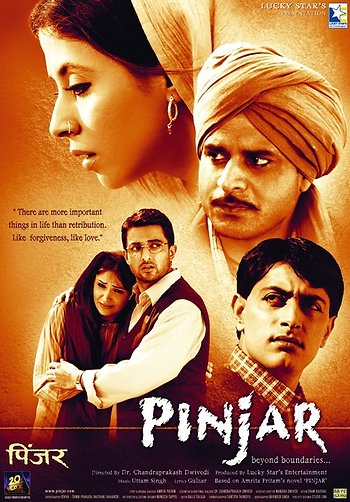
Set in the holy city of Amritsar, the narrator at the very beginning of the movie says that though the names used in the movie are not real but the story is. A story of thousands of houses in Punjab. The protagonist, Puro, is a young beautiful Punjabi woman who is docile, playful and the apple of her father’s eye. Her father wanted to marry Puro off to a simple but scholarly groom, Ramchand. So they go from Amritsar to Chattoani for the wedding, where Puro unfortunately gets abducted by Rashid, a Muslim resident of Chattoani. He later reveals to Puro that their families had been rivals for generations and he had abducted her in revenge for his aunt being kidnapped by her uncle in the past.
The kidnapping of Puro is a turning point in the film as this is where the sub-theme of the movie emerges-Sufferings of women victims of partition. As the news of Puro’s kidnapping reaches her parents her mother broke down and begged Puro’s father to bring her back somehow. To that, he said “If people get to know about this they will look down on us. Even if we find her no one will marry her. It’s best if we consider her dead.”This statement showed how women were a burden which was to be married off and if something unfortunate was to happen to the girl, they would disown her instead of helping her. Now Puro is forcefully married to Rashid and her name is changed to Hamida. This is where Puro’s will, hopes and dreams are crushed and her being dead to her own family turns her into a mourning soul trapped in a ‘Pinjar’ or a mere skeleton.
In 1947, with India’s Independence, came the dreadful event of partition. Sir Cyril Radcliffe, a British official who had never been to India and had no knowledge whatsoever about the cultural background of the people or the religious complexities, was called to draw the lines on the map to divide the Indian subcontinent into Hindustan and Pakistan in just five weeks. Little did the people know that the lines he draws on the maps would alter the lines of their fortune and future. Just on the basis of the religious majority of districts, he drew lines on Punjab and thus Pakistani Punjab and Hindustani Punjab were born. The movie depicts a scene where Puro asks Rashid where they are now and when he says that they are now in Pakistan and her parents are in Hindustan, she breaks down. The following scenes show the ransacking of Chattoani and Rattowal. Houses on flames, women being abducted on horses, men killing each other, not even sparing the children.
Horrifying accounts of survivors have been documented. Women being raped then killed and their bodies being dumped in the village wells, little girls taking poison that their heartbroken father gave them to save them from the horrors of the barbarians, roads being filled with lines of dead bodies, trains reaching the platform with a mass of corpses-all of this truly happened. Something worse than a nightmare. Again the angle of women being used as a tool to tarnish the reputation of communities comes up. One such survivor, Bir Bahadur Singh was only a child then. He recalls when his village was being ransacked by a Muslim mob, a man by the name of Gulaam Rasool came as a negotiator to the survivor’s father. The negotiating term being -the demand of a woman. His father then called his sister, Maan Kaur who was 18 at the time, and took his sword and struck her. He missed her in the first blow, to which her reaction was to lift her braid for her father to have a clear view of her neck. Singh then says, “He struck again and her head rolled off.” That is how people protected their women, their dignity, their pride. All women co-operating and chanting God’s name while being beheaded.
However, there was good on both sides of the border too. Rashid was a righteous man. He never forced Puro for anything, even helped kidnapped girls return to their families as an act to atone for his sin of abducting Puro. People helped other suffering people, gave them shelter, food, hiding places etc. Indeed adversities bring people together.
Pinjar is indeed a poignant account of the bloodshed, the turmoil, the tears of the people. The cast was selected perfectly. The background score and songs of the movie were apt to the scenes portrayed. It won the Special Jury Award at the National Film Awards. The lines drawn on a map resulted in the largest forced migration in the world -about 14 million people. Around one lakh women shared the same fate as Puro- being kidnapped and forced to marry their captors. In the end, I would like to quote the lines of a Punjabi poet Ustad Daman “Akhiya di lali dasdi ae, roye asi vi roye tusi vi.” (The redness in our eyes is testament to the fact that both nations cried). That was the nature of The Partition of India and Pakistan.


Comments